
 Canada New Moms Family
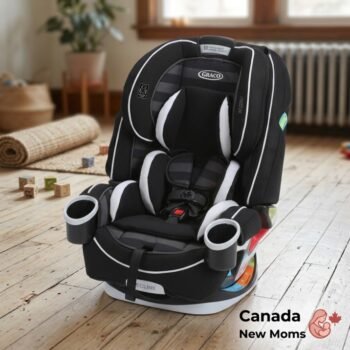
Finding a car seat that genuinely grows with your child sounds too good to be true.
Most "convertible" seats do two or three modes well — and quietly disappoint in the others. The Graco 4Ever is one of the few that actually delivers on the promise of a true all-in-one seat, covering every stage from a hospital-discharge newborn all the way to a booster-age kid heading to middle school.
Here's everything you need to know.
What Is the Graco 4Ever? (The 4 Modes Explained)
The 4Ever is a 4-in-1 convertible car seat, meaning it transitions through four distinct safety stages:
- Rear-facing — from 4 lbs up to 40 lbs
- Forward-facing with harness — from 22 lbs up to 65 lbs
- High-back booster — from 30 lbs up to 100 lbs
- Backless booster — from 40 lbs up to 120 lbs
What sets the 4Ever apart is that it performs well in all four — which, in the convertible car seat world, is genuinely uncommon.
Graco 4Ever Specs at a Glance
| Mode | Weight Range | Height Range |
|---|---|---|
| Rear-facing | 4 – 40 lbs | Until head is 1" below headrest adjuster |
| Forward-facing | 22 – 65 lbs | Under 49 inches tall |
| High-back booster | 30 – 100 lbs | 38 – 57 inches tall |
| Backless booster | 40 – 120 lbs | 40 – 57 inches tall |
Other key specs:
- Expiration: 10 years from manufacture date
- Shell width: 19 inches (20" at cup holders)
- Lower anchor weight limit: 45 lbs (check your manual — older models may be 42 lbs)
- No-rethread harness system
Does the Graco 4Ever Work for Newborns?
Yes — and it's one of the better convertible seats for small babies.
The included infant insert has two separate pieces: a body support and a head support with an adjustable elastic band. Used together, they bring the lowest harness slot down to about 6 inches, which fits most newborns well.
The seat has even been tested with a 4 lb, 17-inch premature infant doll — with the harness landing correctly at the shoulders.
That said, every baby is proportioned differently. If your child was born premature, consult a certified child passenger safety technician (CPST) before settling on any seat.
Assembly note: The cup holders ship unattached and must be clicked into place before first use. The manual walks you through it — takes about 60 seconds. Once attached, they stay on permanently.
How Long Can You Keep Baby Rear-Facing?
Longer than most parents expect — and that's a good thing.
According to the American Academy of Pediatrics, children should stay rear-facing for as long as possible, until they reach the maximum height or weight limit of their seat.
The Graco 4Ever's tall shell and 40 lb rear-facing limit make it realistic for most kids to remain rear-facing until their 3rd or 4th birthday.
The seat has 6 recline positions — positions 1 through 3 are for rear-facing use. A bubble indicator on the side of the seat confirms the angle is correct. If position 1 still isn't reclined enough for a very small newborn, Graco permits using a rolled towel or pool noodle underneath the base.
Installation options:
- Lower anchors (LATCH) — push-button connectors that click in cleanly
- Vehicle seat belt — openings in the seat cover make threading the belt much less of a wrestling match than on competing seats
Forward-Facing Mode: What You Need to Know
Once your child outgrows rear-facing, the 4Ever converts to a forward-facing seat with a 5-point harness.
A few things to keep in mind:
- Recline positions 4, 5, or 6 are used in this mode
- Children under 40 lbs must use recline position 4 (US only)
- The top tether is required for every single forward-facing installation — no exceptions
- The harness should sit at or above the shoulders
The harness adjustment mechanism uses a roller bar at the back of the seat, which makes tightening smooth and easy — no white-knuckle yanking required.
The lower anchors can be used for children up to 42 or 45 lbs depending on your seat's manufacture date. Beyond that limit, switch to the vehicle seat belt plus top tether.
High-Back Booster Mode: When Should You Switch?
Graco lists 4 years as the minimum age for booster mode.
Most child passenger safety experts recommend waiting until your child is at least 5 years old and has genuinely maxed out the harness limits — either by height or weight — before making the transition. A 4-year-old still belongs in a harnessed seat.
When the time comes, the 4Ever's harness storage system is one of its smartest design features: the harness never leaves the seat. It tucks into a hidden compartment behind the seat pad, so nothing gets lost and switching back (if needed) is straightforward.
To convert to booster mode:
- Extend the headrest fully and expose the seat interior
- Open the storage compartment door and tuck the harness straps, chest clip, and buckle tongues inside
- Store the buckle itself in the seat pan compartment
- Set the recline to position 6
The high-back booster can still use LATCH anchors — a feature most boosters skip entirely.
Backless Booster Mode: For the Older Kids
For children who have outgrown the high-back booster, the 4Ever converts to a backless booster (40–120 lbs, 40–57 inches tall).
Conversion involves detaching the back from the base using two red tabs inside the seat pan. The shoulder belt guide on the base helps position the seat belt correctly for smaller kids — for older, taller children the belt typically falls into place naturally.
One important note: In backless booster mode, LATCH cannot be used since the connectors are part of the back that gets removed. Always buckle the seat in when it's unoccupied to prevent it from becoming a hazard in a crash.
Does the 10-Year Expiration Work Out?
Here's the honest answer: mostly, but not perfectly.
If you start using the 4Ever from birth, the seat will expire when your child is around 9–10 years old. Most children still need a booster until they reach about 4'9" (57 inches) — typically around ages 10–12.
So realistically, you may need a basic backless booster for the last year or two before your child is ready to use just the vehicle seat belt.
That's a minor limitation on an otherwise exceptional seat. For the vast majority of the car seat years — from newborn through elementary school — the 4Ever covers it.
Pros & Cons
What We Like
- Works from 4 lbs through booster age
- Compact enough for smaller vehicles
- Push-button LATCH connectors are easy to use
- No-rethread harness saves time at every adjustment
- Smart harness storage system for booster mode
- LATCH permitted in high-back booster mode
- Flat seat bottom minimizes pressure marks on upholstery
Worth Knowing
- No lower anchors in backless booster mode
- Will likely expire 1–2 years before child no longer needs a booster
- Recline position 4 can be tricky in vehicles with sloped seats


Final Verdict: Is the Graco 4Ever Worth It?
For most families — yes, without hesitation.
The 4Ever is well-built, installs reliably, and genuinely performs across all four stages. That's a short list of seats that can say the same. The 10-year expiration is something to plan around, not a dealbreaker.
If you want one seat that covers your child from the hospital to somewhere around fifth grade, the Graco 4Ever is one of the strongest options on the market.

